The lawsuit I recently filed against the MAPCO gas station chain, owned by Majors Management, centers on it collecting taxes on items exempt from sales tax. There’s plenty of details and specifics the lawsuit covers, but for today, I’d like to start by showing a few small examples. Here’s one transaction:

The first line shows transaction details such as the time and date, transaction ID and total collected. Don’t worry, none of the information I’m showing is personally identifiable, I wouldn’t leak people’s credit card numbers or anything like that.
Smartwater is a brand of bottled water. In Ohio, water is not eligible for sales tax. MAPCO collected $0.53 in “tax” on this $7.78 sale of bottles of water anyway. Later the same day, we see:
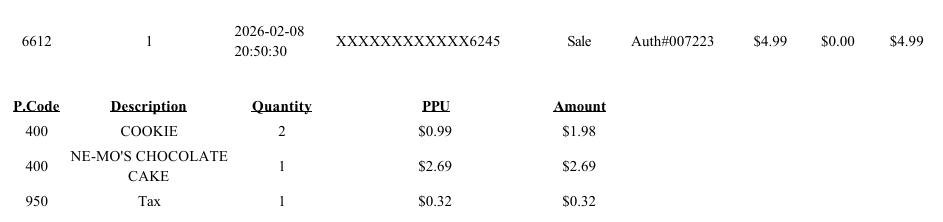
Cookies and cake are exempt from sales tax in Ohio as well. MAPCO charged $0.32 cents on a $4.67 sale of them anyway. The next example gets complicated:
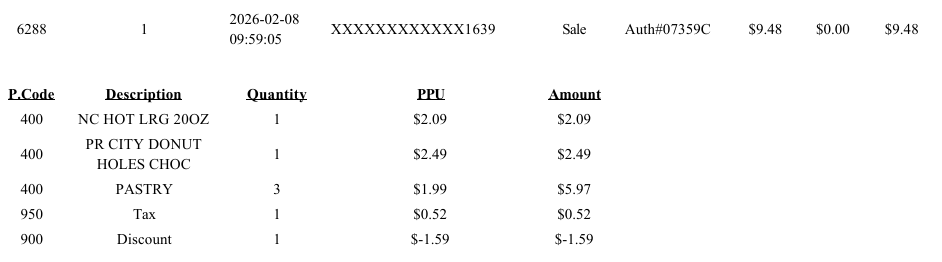
The next section shows a list of the items in the transaction. The first item is a 20 oz coffee, The next item is donut holes. The third item is three pastries, so fresh donuts, muffins, cinnamon rolls or the like. There’s also a $1.59 discount because donut holes and the coffee are set as a $2.99 deal.
$2.09 for the coffee + $2.49 for the donut holes – $1.59 for the deal = $2.99. Three $1.99 pastries comes to $5.97. This gives a total of $8.96. MAPCO charged $0.52 in sales tax. None of these items are eligible for sales tax. But there’s more.
The sales tax at my location was 5.75% state and 1% local, for a total of 6.75%. 6.75% of $8.96 is $0.6048. Why then did MAPCO charge $0.52 in tax? The 8 cents in “tax” that’s missing represents ~$1.20 in sales. No item cost that much. What happened is MAPCO did not collect tax on the coffee, as in transactions like this one:

But part of the $1.59 discount was applied to the coffee, meaning it was calculated to only cost ~$0.80 which were not taxed while part of the discount was applied to the donut holes which were.
Confused? Don’t worry, it doesn’t make much sense. That’s why I wanted to share this example. Not only were none of the items in these examples supposed to be taxed, how much tax is incorrectly charged on them is often inconsistent. In fact, MAPCO’s methods of calculating “tax” to charge on items can be so strange they charge negative sales tax.
I’ll be writing about that insanity in a future post, but in the meantime you can read about it in the lawsuit I filed, which is available online here.
Leave a Reply